
Wintertime in New England presents massive challenges for all wildlife, but can be especially tough for those birds who remain behind and do not migrate. Our recent and historic blizzard was a pronounced reminder of the conditions that our feathered friends encounter through the blustery months.
In particular, birds face the dual threat of the extreme weather conditions (such as the long stretch of sub-freezing temperatures we experienced in January and February), and the accompanying reduction in food supplies. It’s tough being a bird out there!
A Fancy Winter Coat
Fortunately, the remarkable coat of feathers that birds wear not only serve as an attractive lure to potential mates in their spring colors. Birds rely on their own natural “down jackets.” In the extreme cold, birds can create insulating pockets simply by fluffing their feathers to trap heat. Once they have trapped heat, birds can even adjust the fluffiness of their feathers, essentially creating a natural thermostat to regulate their body temperature! Other birds, such as cormorants, have a natural oil coating to their feathers, which can also help to trap heat and to keep warm against the cold.


It Pays to Have a Pantry
Bird species that do not migrate still need to eat and manage their survival. During these lean times, many birds switch over to feeding on seeds and berries – where they can be found – from insects. The classic sign of this is the American Robin feeding on holly berries, but other birds will do this, too. Nuthatches and creepers, for instance, will create “pantries” in the trees that they are usually probing for insects. While the bugs that they usually would gorge themselves on are in slumber, birds need to keep up a high metabolic rate, and that means going to their stockpile for crucial plant byproducts rather than grubbing on larvae. When you have to eat your entire body weight in one day just to survive the night, it pays to have a pantry!
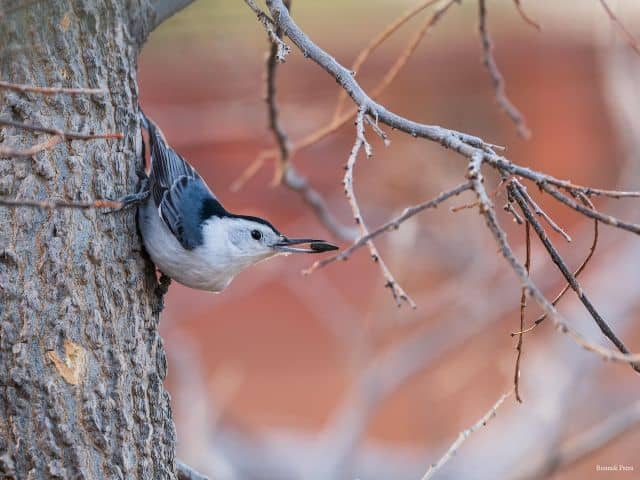
Another interesting technique for surviving the brutal winters involves creative techniques for exchanging and preserving body heat in numbers. Visitors to Westport Woods are often surprised that we are still visited by bluebirds, and sure enough, they are often here all winter. Species like the Eastern Bluebird, Brown Creeper, and even American Goldfinch (often hard to spot in wintertime) will actually huddle as a group to keep their body heat preserved in a mass. By late summer, such birds will have spread out across their habitat, feeding at will. But in cold February, you might be deep in the woods before coming across a flock of goldfinches.


Sounds of Spring
The waning days of winter will soon give way to the longer days of spring. As the days get longer, the volume gets louder, and each morning the chorus of birds grows stronger. As the lean, cold days come to a close, birds are beginning to find food more easily, and their attention turns instead to finding a spring fling! Spring songs serve multiple purposes, but foremost are the attraction of a potential mate, and alerting the neighbors to their presence, essentially marking their territory. Listen at the crepuscular hours (dawn and dusk) and you may hear one of our local owls calling for a mate!
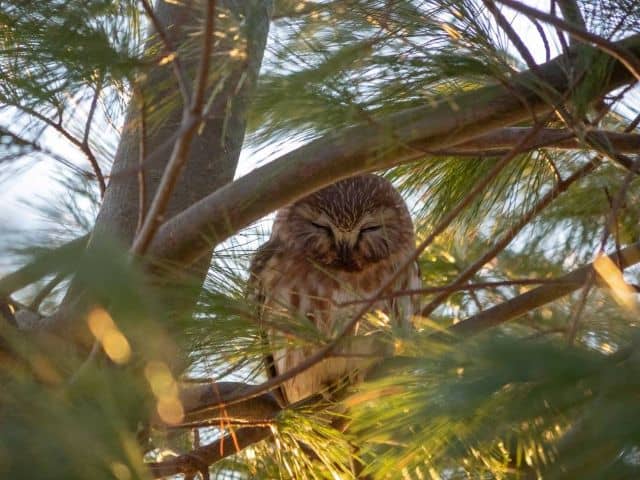
Westport’s location on the Atlantic Flyway means that by late March, we’ll be starting to see the coming of a bevy of new species to our area. It’s a far cry from the scarcity of deep wintertime when the calls of migratory songbirds, new waterfowl and the quintessential coastal predator, the Osprey make their return. But as of this writing, an Osprey was observed as close by as Newport County. Whether this is an individual bird knocked off course by the extraordinary weather systems that carried the Blizzard of 2026 through our region, or if it was just an especially early prospector laying claim to his summer home, it feels like a harbinger of warmer weather just around the corner!
Here are some other ways you can welcome the birds of spring this March:
- The Early Bird: Fundamentals of Birding – a three-part series for new and new-ish birders, hosted on Mar. 11, Mar. 18, and Mar. 25
- Bird Box Building Workshop – a family-oriented workshop in which we will build a nestbox for migrating spring birds, on Mar. 14
- Eyes On Owls – a live owl program on Mar. 21
We hope to see you early birds on the trails!