
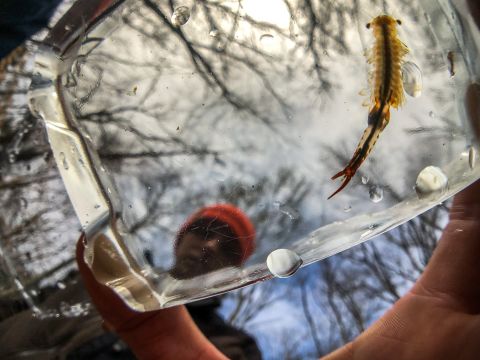
This month we are celebrating the emergence of Spring, and examining vernal pools. These fascinating forest water bodies contain species that fill our summer nights with sound, and even contain species of fairies (albeit the shrimp version). They are also one of the most sensitive habitats in our region, often being disturbed by development and human “management.”
MassWildlife, a division of the Commonwealth’s Office of Energy and Environmental Affairs, offers landowners an opportunity to certify a vernal pool by documenting the various species in it. While this may not be appropriate for everyone’s property, it does help provide a larger data set for biologists to examine.


Habitat, Biodiversity and Land Preservation
Identifying bona fide habitat data is crucial when thinking about land preservation. Here at WLCT, we work with the Westport community, the Town, and the Commonwealth to identify the lands with the greatest conservation benefit for the community. One of the key conservation characteristics we focus on is habitat that enhances biodiversity. When a forest, wetland, or shrubland is healthy and plentiful with varied wildlife, it improves the quality of our lives. These are the areas we focus on for preservation!
Vernal pool certification is a series of steps that identifies the obligate species–those that require a vernal pool to reproduce. But this process isn’t the only way to support data collection. When you upload photos to iNaturalist or ebird in order to identify plants, animals or birds, you add to a vast data set scoured by biologists confirming the viability of species in a certain location. The process certifying a vernal pool, citizen scientist platforms including Heritage Hub, or interacting with local wildlife specialists are all ways to record the species. We use that information to determine the biodiversity of the landscapes that are key to preserving our community’s health.
Explore!
Perhaps the most important thing you can do for our natural habitats and their specific species is get outside, experience and explore Westport’s habitats. Be curious! Use the tools mentioned above, ask questions, or attend a program, like our Vernal Pool Exploration on April 18th. Understanding the plants, animals, and geology of the land is the first step in preserving it.