

WLCT asked landowner Rob Bryan to talk about caring for his forested land for our 2025 Week of Thanks.
In the 1980s, Rob’s family donated 40 acres to WLCT which became the Old Harbor Wildlife Refuge. These acres, as well as abutting property owned by Rob and his extended family, are part of a parcel purchased more than 100 years ago. Together, they form a corridor Conservation Restrictions in an area that has seen a lot of development in the past 40 years. The blue trail loop at Old Harbor Wildlife Refuge crosses these private lands thanks to the donation of a public trail easement, maintained by WLCT staff and Trail Team volunteers.

“You don’t really own a land, it’s just your turn to take care of it.”
image: 28″ oak stump harvested from River Road, with growth rings labeled from 1873 (far right) to date of cut, 2014 (far left)
Local Forestry from Local Farmland
The properties are laced with stone walls which once marked the fields and pastures of a family farm. In the late 1800s, the abandoned farmland gave root to a forest of black and white oaks, red maple, tupelo, hickory and holly. Today, Rob’s land is enrolled in the Commonwealth’s Chapter 61 forest management program, a planned, sustainable management approach under which the trees are periodically harvested for lumber or firewood. The forest habitat diversifies while continuing to sequester carbon. Sensitive habitats like the tupelo-red maple swamp, stream, and vernal pool are buffered. At the same time, these partial harvests allow filtered light to reach the forest floor and encourage a new cohort of seedlings to take root.
A stream, racing with winter rain, crosses the property. Streamside habitats are different than those found on higher ground, adding to the diversity of plants and wildlife found on Rob’s property.

Challenges of Forested Land
Because deer prefer to browse on the seedlings of oak, maple, and hickory–and prefer to avoid non-native invasives and some native shrubs–Westport’s vastly overpopulated deer herd is threatening the forest. I have granted permission to several local hunters who take home healthy wild venison to share with family friends. Their harvests help control the local herd (who also suffer when overpopulated) and allow some new trees to become established. As deer avoid most non-native plants, keeping these exotics in check has become part of my annual work plan.
While deer threaten the forest from the floor, invasive insects, like winter moth and spongy moth, have killed many overstory trees. Beech leaf disease, caused by a nematode only recently discovered, is killing beech trees across Westport.
“I am pushing back against threats where I can. But some challenges can only be anticipated and adapted to. The warming climate has changed what thrives in Westport’s forested land. In planning for the future, I am managing my forest for a diversity of species that are adapted to warmer winters and drier summers.”
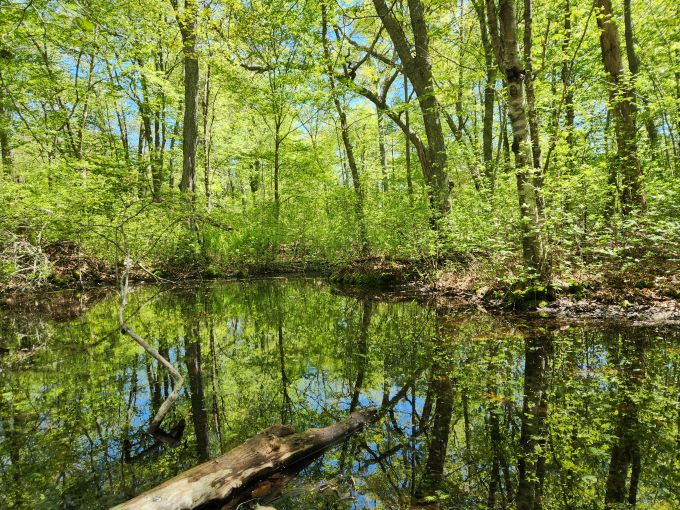
Changes to the climate effect vernal pools, in particular. These temporary ponds fill with water during the winter and spring and are the breeding home for several amphibians, including the Jefferson salamander and the Blue-spotted salamander.